 |
COLLINS, Philip
Philip Collins (b. 1951), composer, music director, conductor, guitarist, teacher, and arts administrator, is co-founder of the contemporary music concert series, New Music Works (NMW) of Santa Cruz, California (est. 1979). As Artistic Director for the organization and conductor of the NMW Ensemble, Collins has maintained an explorative agenda that builds upon the intersections and divergences of contemporary music's infinite paths. Collins' programs will often juxtapose today's most challenging repertoire with simple music of primitive means, or vibrant, dust-gathering works of the past one hundred or so years.
Collins writes for orchestra and chamber groupings of numerous types. His works have been performed throughout the U.S. and abroad by groups including the Cabrillo Festival for Contemporary Music, Contemporary Music Ensemble Korea, the San Jose Chamber Orchestra, the Santa Cruz Symphony, and the Parallèle Ensemble. He has composed a great deal for musical theatre, and in recent years has supplied scores for a number of classic silent films, including, most recently, Fritz Lang's "Metropolis" and Thomas Edison's "Frankenstein." Collins has composed scores for over 20 music theatre productions, including five critically acclaimed revivals of classic Grecian plays, commissioned by translator Mary-Kay Gamel.
Collins was the recipient of the 2011 Santa Cruz County Artist of the Year Award, and the Bay Area Dramalogue Award. His compositions placed first at the L'ARCIM Festival in Montreal and the International Clarinet Society Composition Competition. He has served in residence at Vassar College, Cabrillo Festival of Contemporary Music, San Francisco Conservatory of Music, and in 2007 was a featured lecturer at the Asian Composer League Conference in Wellington, New Zealand.
Collins studied composition with Lou Harrison, Edwin Dugger and Henry Onderdonk, and conducting under Nicole Paiement. He holds a Bachelor of Arts in Composition (San Francisco State University) and a Masters in Conducting (UC Santa Cruz).
|

|
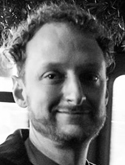 |
COTTON, Adam
Adam Cotton (b. 1979) was born and raised in Austin, Texas, where he started playing guitar and writing songs at age twelve. After a few years in bands experimenting with different musical ideas he eventually went on to major in music at UC Santa Cruz, where he studied composition, classical guitar and electronic music. He received the Dean's Undergraduate Award for his String Quartet No. 1: The Waves. His music has been performed in Tennessee, Indiana and California. Currently Adam mostly writes and performs with his band New Planets in Los Angeles, California, as well as pursuing various explorations and collaborations in composing and performing classical, electronic, and acoustic music.
|
|
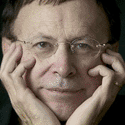 |
NEWMAN, Anthony
For over 26 years, the multifaceted Anthony
Newman (b. 1942) has been in the public eye as
one of the country's leading organ virtuosos and
as a prodigiously active harpsichordist, fortepianist,
conductor, composer, writer and recording artist.
Time magazine described him as the “high
priest of Bach.” As a composer, his works
have been heard in such cities as Paris, Vienna,
Budapest, Krakow, Warsaw, New York, and London.
His compositions include five concertos, three
orchestral sinfonias, numerous choral works, a
complete set of piano preludes and fugues in every
key, and a variety of works for organ and guitar,
as well as chamber music for strings, winds and
brass.
Anthony Newman’s prodigious recording output
numbers more than 140 CDs, covering a full range
of styles from the 17th century to the 20th century,
on such labels as CBS, Sony, Deutsche Grammophon,
and Vox Masterworks. Many of his recordings have
been singled out for excellence, and his 1989
fortepiano performance of Beethoven's Third Concerto
was chosen by Stereo Review as "Record of
the Year". A frequent collaborator with many
notable artists, Newman recorded “In Gabriel’s
Garden” with Wynton Marsalis and the English
Chamber Orchestra on Sony Classical, which was
the best-selling classical CD in 1997.
Newman has guest-conducted many of the world’s
greatest chamber orchestras, including those of
Los Angeles, the 92nd Street Y in New York, the
New York Chamber Orchestra, the Scottish Chamber
Orchestra, and the St. Paul Chamber Orchestra.
A series of orchestral conducting triumphs with
the Seattle Symphony, San Francisco Baroque, and
New York Chamber Orchestra during the 1997-98
season raised him to the top ranks of Baroque
and Classical specialist conductors. At Lincoln
Center alone, he has appeared more than 50 times
as soloist during his career. His duo appearances
with flutist Eugenia Zuckerman at the New York
Public Library are now in their 15th year. Among
his more unusual European appearances are the
first performance of Hindemith’s Sancta
Suzanna in chamber version. In East Germany, he
conducted the first performance of Cesar Franck’s
Chasseur Maudit and Liszt’s Les Preludes
since the end of World War II.
Born in Los Angeles, Newman studied in Paris
with Alfred Cortot, Nadio Boulanger and the famed
organist Pierre Cochereau. He received a Diplome
Superieur from the Ecole Normale de Musique with
a special commendation from Cortot. In the United
States, he trained with pianist Edith Oppens and
composers Leon Kirchner and Luciano Berio, and
served as choral assistant to New York Pro Musica
Director Noah Greenberg.
Newman's own teaching career has included positions
at the Juilliard School and Indiana University,
and he currently heads the graduate music program
at Purchase College of the State University of
New York. He also serves as director of music
for St Matthew's Church in Bedford, NY. He is
the founder and administrator of Hands On Outreach,
an organisation that provides food to shelters
and the indigent in White Plains, New York, and
is a member of Hospice, a national organisation
dedicated to providing comfort to the terminally
ill. In Europe, he has served as Dean of the European
Mozart Academy in Krakow, Poland.
|
|
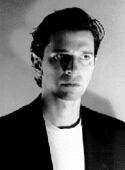 |
ORTIZ,
Pablo Victor
Pablo Ortiz (b. 1956) is a Guggenheim Fellow,
Charles Ives Fellow of the American Academy of
Arts and Letters, and recipient of Fromm Foundation
and Koussevitzky Foundation Commissions. He was
first trained in his native Buenos Aires, where
he received a degree from the Universidad Catolica
Argentina. At 27, he moved to New York to study
at Columbia University. He studied composition
with Mario Davidovsky, Chou Wen Chung, Jack Beeson,
Jacques Louis Monod, Fred Lerdahl, Gerardo Gandini,
and Roberto Caamano. At present, he is Professor
of Composition at the University of California,
Davis. He taught composition and was co-director
of the Electronic Music Studio at the University
of Pittsburgh from 1990 to 1994.
Among those who have performed his compositions
are the Buenos Aires Philarmonic, the Arditti
String Quartet, Speculum Musicae, the Ensemble
Contrechamps of Geneva, Music Mobile, Continuum,
Les Percussions de Strasbourg, the San Francisco
Contemporary Music Players, and the Theatre of
Voices. His music has been heard at international
festivals in Salzburg (Aspekte), Geneva (Extasis),
Strasbourg (Musica), Havana, Frankfurt, Zurich,
Sao Paulo and Mexico City.
Ortiz was a fellow at the Composers' Conference
at Wellesley College in 1986 and 1988, and he
was commissioned by the Fromm Foundation in 1992.
In 1993, he received a Guggenheim Fellowship.
In 1996 he received the Charles Ives Fellowship
from the American Academy of Arts and Letters.
In 1997 and 1998, Ortiz was commissioned two chamber
operas, Parodia and Una voz en el viento, by the
Centro Experimental Teatro Colon in Buenos Aires.
In 1999 he was commissioned by the Koussevitzky
Foundation to write a piece, Raya en el mar, for
the San Francisco Contemporary Music Players.
In 2000 he received a grant from Fideicomiso para
la cultura Mexico-US to write children's songs
based on poems by Francisco Alarcon, renowned
Chicano poet and Mission artist. In 2003, he was
commissioned by the Gerbode Foundation to write
a piece for Chanticleer and the San Francisco
Contemporary Music Players, premiered in March
2004. His works include chamber and solo music,
vocal, orchestral, and electronic compositions,
and music for plays and films.
|
top
|
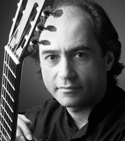 |
ÖZGEN,
Mesut
Guitarist-composer Mesut Özgen (b. 1960)
has performed and taught master classes throughout
the United States, Spain, and Turkey and has been
a guitar faculty member at the University of California,
Santa Cruz since 1998. In addition to being a
prizewinner in the International Portland Guitar
Competition, he has performed as featured soloist
in many festivals, including the International
Paco Peña Guitar Festival in Cordoba/Spain,
Santa Cruz Baroque Festival, Yale Guitar Extravaganza,
Healdsburg Guitar Festival, April in Santa Cruz:
Contemporary Music Festival, Cabrillo College
Distinguished Artists Series, Istanbul CRR concert
series, and UCSC Arts & Lectures Series.
Özgen's compositions are mainly based on or
influenced by traditional Turkish music. Among his
other influences are Spanish composer Joaquin Rodrigo's
use of flamenco music and Turkish scholar/composer
Yalç¦n Tura’s harmonization techniques.
His unique style is comprised of dissonant harmonies
- evoking microtones of traditional Turkish music,
tonal folk-like melodies, and irregular rhythms.
Özgen has also long been a strong advocate
of new music for guitar and frequently collaborates
with other composers. Composers who have written
solo, concerto, and various ensemble music for Özgen
include Anthony Newman, Anthony Gilbert, Pablo Victor
Ortiz, Benjamin Verdery, Deepak Ram, Christopher
Pratorius, Robert Strizich, Charles Nichols, Paul
Nauert, Yalç¦n Tura, Jack Vees, David Cope,
and Philip Collins. Özgen's solo CD "Troubadour"
on Golden Horn Records feature classical guitar
works inspired by Turkish, Spanish, Argentinean,
and American folk traditions and was reviewed
by the Acoustic Guitar magazine as " stunningly
versatile and expressive throughout." He was also described as a “highly accomplished and exciting player who gets the most out of the music he plays”by the Classical Guitar magazine of England. His
award-winning multimedia concert DVD "New
Dimensions in Classical Guitar" on Turquoise
Guitar Editions includes premiere performances
of new guitar works with visual accompaniments
comprising video, interactive computer images,
and particularized lighting design. It was reviewed
by the Classical Guitar magazine of England as
"the finest music DVD ever to have come my
way, remarkable achievement."
Website:
mesutozgen.com
|
top
|
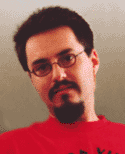 |
PRATORIUS,
Christopher
Christopher Pratorius (b. 1974) is a Santa
Cruz composer with over 20 premieres to his credit.
He received both his B.A. and M.A. in Music from
the University of California, Santa Cruz, and
is currently a lecturer there teaching theory
and group piano. His compositional interests include
modern modal theory including modal chromaticism
and synthetic modes, setting Spanish-language
poetry using varied art-song forms, incorporating
modern dance rhythms into concert music and creating
music that speaks to multiple audiences.
His compositions include many pieces for solo
voice with varied accompaniment, chamber music
including solo guitar music, large ensemble pieces
and original songs in both English and Spanish.
"By the Sea", composed for the UCSC
Orchestra was premiered under the direction of
Nicole Paiement in 2001. "Madrigal: Neruda‚s
Poema 20" for soprano, cello, alto flute
and piano won the 2001 Sound Horizons competition
and was programmed on New Music Works Greatest
Hits concert celebrating their 25th anniversary
in 2004. "Sonata: Ondas do Mar de Vigo"
for guitar was recorded by Mesut Özgen on
his CD Troubadour and premiered as part of the
multimedia "New Dimensions in Classical Guitar"
concert series. "Mañana, tan linda",
an original Spanish language song was recorded
by Nova Trova on their CD "Agua".
Commissions include "Cantigas de mi Amigo
Martin" for the UCSC Women‚s Chorale
conducted by Lucik Aprahamian, "Federico
Canta" for soprano and clarinet commissioned
by Laura Anderson, and most recently "Snapshots
by the Bay" for the UCSC Guitar Ensemble
directed by Mesut Özgen. Current projects
include another guitar sonata for Mesut and a
song-writing collaboration with local Latin American
folk music singer Melinda Velasco-Martinez. In
addition to composing and teaching, Chris is the
accompanist for The Studio School of Classical
Ballet.
|
top
|
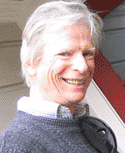 |
STRIZICH,
Robert
Robert Strizich (b. 1945) studied music at
the University of California at Berkeley, where
he earned a B.A. in music and an M.A. in composition.
A Hertz Fellowship from UC Berkeley enabled him
to spend several subsequent years in Switzerland,
studying at the Musikakademie in Basel. After
returning to the USA, he completed a Ph.D. in
composition at the University of California at
San Diego, where his principal teachers were Robert
Erickson, Will Ogdon, Bernard Rands, and Roger
Reynolds. During the 1996-97 academic year, he
was a Visiting Scholar at Stanford University's
Center for Computer Research in Music and Acoustics
(CCRMA).
Strizich has composed a variety of works for
instrumental, vocal and electroacoustic media,
many of which are published by Fallen Leaf Press
(Berkeley), Drake Mabry Publishing (San Diego
and Paris), and Bèrben Editore (Ancona,
Italy). He has fulfilled commissions from various
performers, ensembles, arts organizations and
dance companies, and his music has been performed
in the United States, Europe, and South America.
His work has also been recognized by grants and
awards from the National Endowment for the Arts,
the National Endowment for the Humanities, Wellesley
College, and the Universities of California at
Santa Cruz and Berkeley (including UCB's Eisner
and Nicola de Lorenzo Prizes).
Strizich's music has been presented on the West
Coast by both Earplay and Composers Inc. in San
Francisco, the Festival of New American Music
at California State University in Sacramento,
and in Santa Cruz by New Music Works and the new
music festival April in Santa Cruz. His works
have also been performed by Ensemble Nova, the
new music ensemble at UC Santa Cruz, who have
recorded his Tombeau, Fantasia and Aphorisms on
a CD of new music for early instruments that was
recently released by Musical Heritage Society.
Another of his works for early instruments --
his Contreparties for baroque lute and harpsichord
-- appears on a recent Wildboar CD.
Strizich's "still and still moving..."
for large chamber ensemble was premiered in 1998
by the American Composers' Orchestra at Merkin
Concert Hall in New York City, and then performed
again the following year by Música Aperta
in Washington, D.C. His "look(ing)..."/five
poems of e. e. cummings for soprano, clarinet
and piano was recently premiered by the ensemble
"Schwungvoll" in San Francisco. La Guitarra,
a work based on poetry of Federico García
Lorca for soprano and guitar, was commissioned
by the Porter College Hitchcock Poetry fund and
written for guitarist Mesut Özgen.
The author of various papers on music theory
and performance practice, Robert Strizich has
also taught composition, music theory, music history
and performance at Wellesley College, Trinity
College (Hartford), the San Francisco Conservatory
of Music, San Francisco State University, University
of California at Santa Cruz, and California State
University at Fresno.
|
top
|
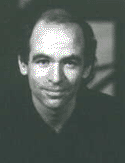 |
VEES,
Jack
Jack Vees was born in Camden, New Jersey in 1955.
His early musical training was in piano and tuba,
but he soon switched to the electric bass guitar.
He attended Glassboro State College and went on
to receive his M.F.A. from California Institute
of the Arts, where he studied music composition
with Morton Subotnick, Stephen Mosko, Louis Andriessen,
Vinko Globokar, and Bernard Rands.
Vees's works have been performed throughout the
U.S., Canada, and Europe by numerous ensembles
and soloists for whom he has written, including
Ensemble Modern, the California Ear Unit, Zeitgeist,
Hemispheres, Jeffrey Krieger (electric cello),
and Amy Knoles (electronic percussion). He performs
his music with his own ensemble Chez Vees, which
consists of electric oboe, percussion, computer/midi
electronics, and Vees on bass and electric guitars.
His mastery of extended techniques on the bass
led him to write the Book on Bass Harmonics (Alfred
Music Publishers, 1981) which has become a standard
reference on the subject. Vees is currently operations
director and instructor of electronic music at
Yale University's Center for Studies in Music
Technology.
Major performances of Vees's works include New
Music America, Neue Musik New York/Cologne, Bang
On A Can, and Soundings. He has been commissioned
by Ensemble Modern, Music In Motion (with the
California Ear Unit), the Minnesota Composers
Forum, Zeitgeist, and Corn Palace Productions
among others, and has been in residence at Duke
University (with Chez Vees) and the Yellow Springs
Institute (with oboist Libby Van Cleve and composer
Eleanor Hovda). Vees has also participated in
numerous collaborations with choreographers and
video artists.
The Music of Jack Vees
Jack Vees has developed a particularly distinctive
and personal musical style that is instantly recognizable.
Starting out as an electric bassist in his early
teens, he went on to study composition with some
of today's most provocative composers, including
Louis Andriessen and Vinko Globokar. His music
un- selfconciously combines rigorous formal thinking
with the raw energy of rock and roll. His manic
bass solo John Henry has the distinction of being
the only piece at the Bang On A Can festival to
literally bring the house down (little pieces
of it anyway).
Technology is an integral part of much of Vees's
work, and he elegantly combines electronics with
acoustic and electric instruments. His own touring
ensemble Chez Vees includes oboist Libby Van Cleve,
Jack's basses and guitars, and computer-driven
midi electronics. But Vees is not dependent on
technology to realize his ideas. Stigmata Non
Grata, for four hand bell players, uses these
rather clumsy traditional instruments in surprising
and beautiful ways.
Jack Vees writes serious, challenging music,
yet he always seems to find a way of exercising
his irreverent, acerbic wit, if only in his program
notes (e.g. the Secret Notes of Tattooed Barbie).
At times the humor is a by-product of a novel
musical or theatrical idea. Child Bride requires
the cellist to finger with both hands while four
assistants bow the strings with strands of fishing
line.
|
top
|
|
|
 |
| |
|
|
|